Hardware HSM vs Browser HSM: Choosing the Right Cryptographic Signing Method
YubiKey, Smart Cards, or Browser-Based Keys? A Comprehensive Enterprise Guide to Modern Cryptographic Signing
Enterprise document security is undergoing a fundamental transformation.
For years, digital signing systems were treated primarily as workflow tools:
- upload document
- authenticate signer
- apply signature
- archive file
Today, enterprise signing systems sit at the intersection of:
- cryptographic trust
- identity assurance
- compliance governance
- zero-trust architecture
- insider threat mitigation
- long-term auditability
- document integrity verification
Where should cryptographic trust actually live?
Should enterprises rely on:
- Hardware HSMs?
- Smart cards?
- YubiKeys?
- Browser-based cryptographic systems?
- Cloud signing providers?
- Device-bound local cryptography?
- threat models
- regulatory requirements
- operational scale
- workforce distribution
- trust assumptions
- exposure tolerance
What Is a Hardware Security Module (HSM)?
A Hardware Security Module (HSM) is a specialized cryptographic device designed to:
- generate secure keys
- isolate private keys
- prevent extraction
- enforce tamper resistance
- execute cryptographic operations securely
- banking infrastructure
- payment systems
- certificate authorities
- government systems
- defense environments
- enterprise PKI deployments
- Thales HSM
- Entrust nShield
- AWS CloudHSM
- Azure Dedicated HSM
- FIPS 140-2 / 140-3
- Common Criteria
- PCI DSS cryptographic controls
Traditional Hardware HSM Architecture
Hardware HSM environments typically centralize signing infrastructure inside controlled enterprise systems.
This provides:
- strong centralized governance
- strict certificate lifecycle management
- secure auditability
- hardware-backed isolation
- tamper-resistant cryptographic boundaries
But centralized signing infrastructure also introduces architectural tradeoffs.
The Hidden Problem With Traditional eSignature Platforms
Many cloud-based signing systems still rely on centralized document processing pipelines.
This means documents often move through:
- vendor infrastructure
- third-party systems
- cloud processing layers
- metadata extraction systems
- remote signing environments
- insider access risks
- metadata leakage
- centralized retention concerns
- AI ingestion exposure
- compliance uncertainty
- jurisdictional ambiguity
- vendor trust dependency
The issue is architectural exposure.
Image: Traditional Cloud Exposure vs Local-First Processing
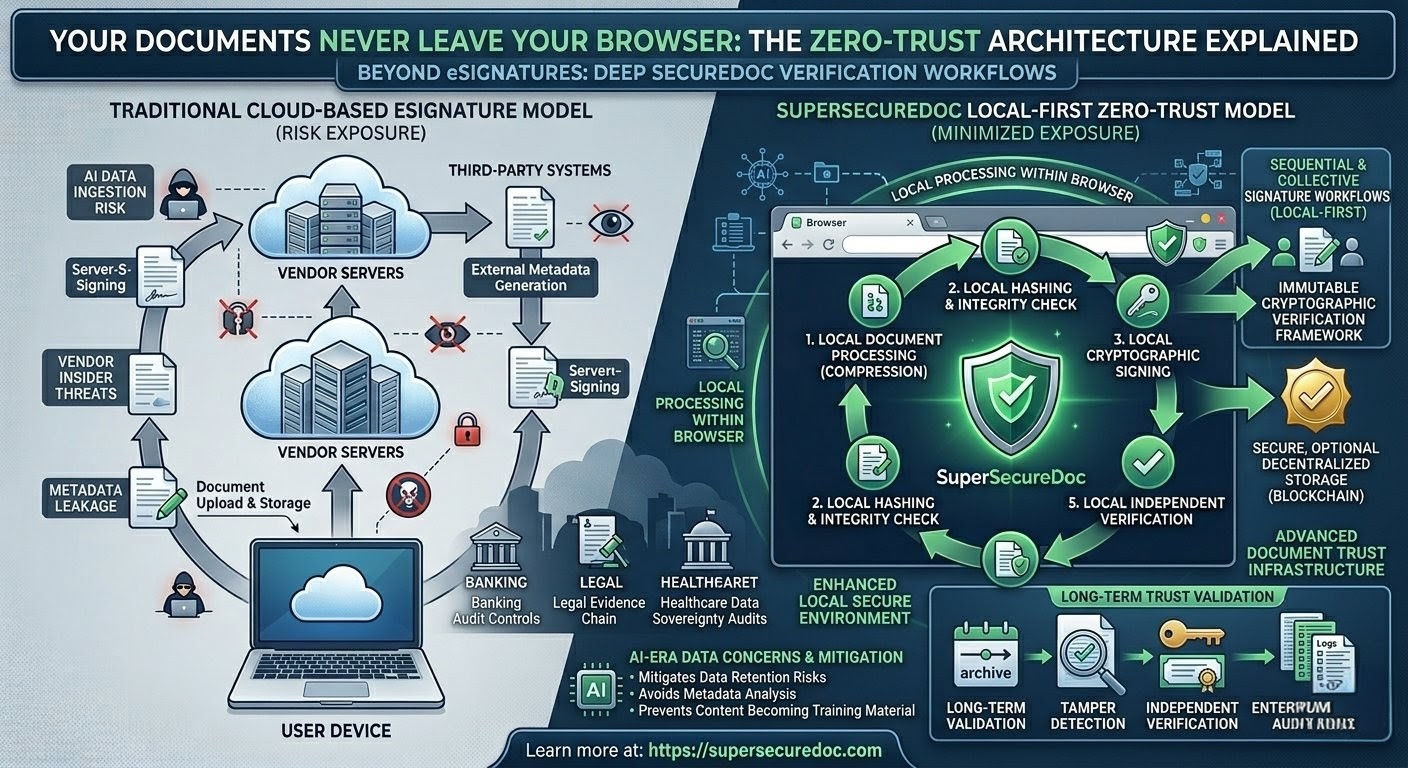 Figure: Traditional cloud-centric signing models expand attack surfaces through centralized processing layers, while local-first browser cryptography minimizes unnecessary exposure boundaries.
The Rise of Browser-Based HSM Architectures
Modern browsers now support advanced cryptographic capabilities including:
- WebCrypto APIs
- device-bound key generation
- secure local hashing
- isolated browser execution
- TPM integration
- Secure Enclave integration
- WebAuthn support
Browser-Based HSM Architectures
In this model:
- signing occurs locally
- cryptographic operations remain device-bound
- documents stay within the browser environment
- private keys never require centralized vendor exposure
- zero-trust security principles
- local-first architecture
- data minimization strategies
- modern privacy requirements
What Is a Browser-Based HSM?
A Browser-Based HSM is not a physical appliance.
Instead, it is an architectural trust model where:
- cryptographic operations execute locally
- browser APIs handle signing
- private keys remain isolated
- document processing occurs client-side
- TPM hardware
- Secure Enclave
- Windows Hello
- device-bound credentials
- passkey infrastructure
Hardware HSM vs Browser HSM
Security Comparison
| Category | Hardware HSM | Browser-Based HSM | | -------------------------- | ------------ | ----------------- | | Physical Tamper Resistance | Excellent | Moderate | | Centralized Governance | Excellent | Moderate | | Local Privacy | Moderate | Excellent | | Zero-Trust Alignment | Moderate | Excellent | | Deployment Simplicity | Low | High | | Infrastructure Complexity | High | Low | | Remote Workforce Support | Moderate | Excellent | | Cost Efficiency | Low | High | | Offline Capability | Moderate | Excellent |
The “better” architecture depends entirely on enterprise requirements and threat models.
Where YubiKeys and Smart Cards Fit In
YubiKeys and smart cards represent a middle ground between centralized HSM systems and browser-native cryptography.
They provide:
- portable hardware-backed credentials
- phishing-resistant authentication
- MFA integration
- hardware key isolation
- strong identity assurance
- physical possession requirements
- strong credential protection
- portable cryptographic identity
- hardware-backed trust anchors
- hardware logistics
- user friction
- lost-device management
- support overhead
- enterprise provisioning complexity
For others, browser-native cryptography offers a more scalable operational balance.
Why Local-First Cryptography Matters in the AI Era
AI-era data concerns are fundamentally changing enterprise security priorities.
Organizations increasingly ask:
- Who processes our documents?
- Where are signatures generated?
- Can uploaded files persist?
- Are documents used for AI training?
- What metadata becomes visible?
- Which jurisdictions touch our data?
- minimizing unnecessary transmission
- reducing centralized processing
- limiting metadata exposure
- supporting data minimization principles
- reducing cloud dependency
- banking
- legal infrastructure
- healthcare
- defense contractors
- regulated enterprise systems
Compliance by Design: The Local-First Advantage
One of the largest enterprise shifts is the movement toward:
compliance-native architectures
Instead of adding compliance later, organizations increasingly want systems architected around:
- minimized exposure
- local processing
- auditable verification
- jurisdictional control
- cryptographic integrity
Image: Compliant Document Lifecycle
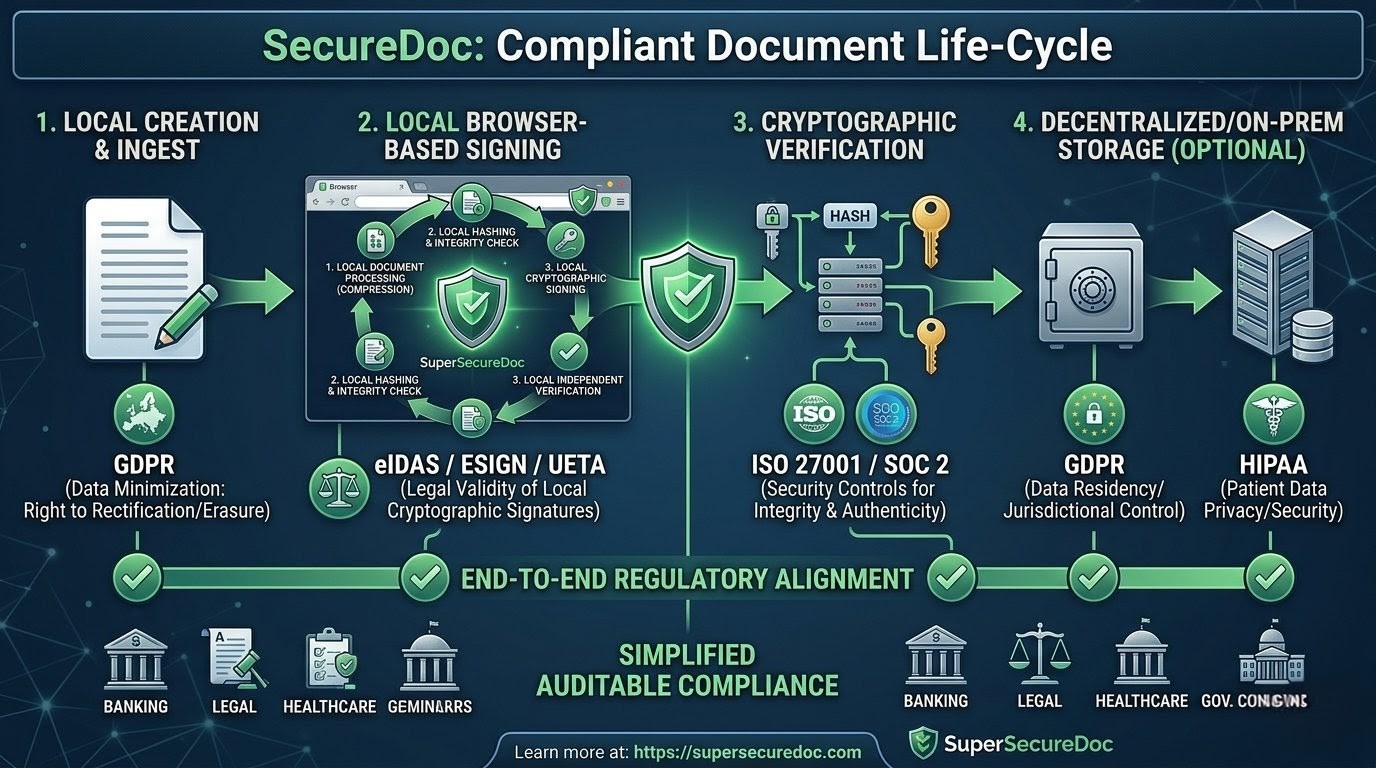 Figure: A local-first signing lifecycle can help organizations align more closely with GDPR data minimization, SOC 2 security controls, HIPAA privacy requirements, and modern zero-trust governance strategies.
Beyond eSignatures: Immutable Trust Infrastructure
Traditional eSignature systems often stop at:
“The document was signed.”
Modern enterprise verification systems go much further.
They focus on:
- immutable auditability
- tamper detection
- cryptographic integrity proof
- long-term verification
- independent validation
assuming trust
to:
cryptographically proving trust
Image: Immutable Verification Infrastructure
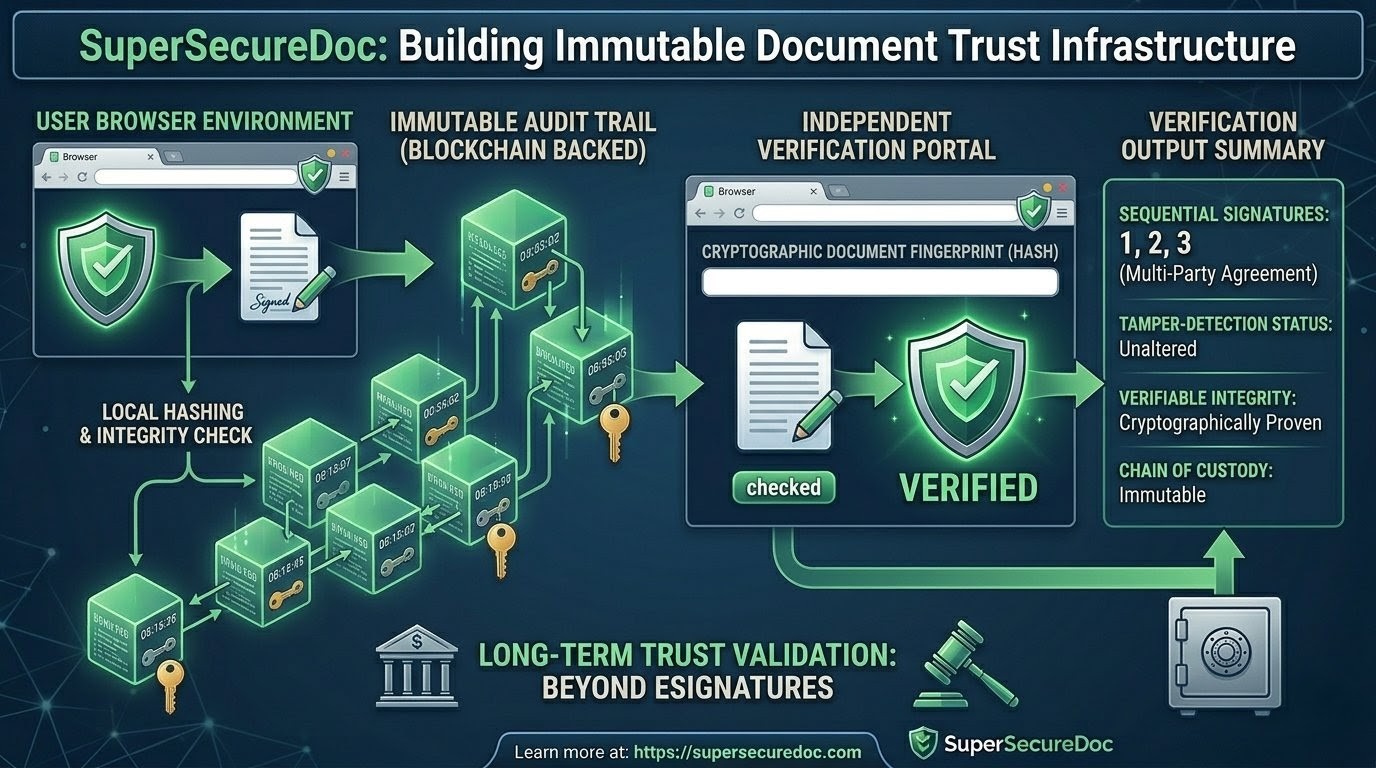 Figure: Immutable verification infrastructure enables long-term trust validation through cryptographic fingerprinting, tamper detection, and independently verifiable audit trails.
The Enterprise Shift Toward Hybrid Trust Models
The future of enterprise signing infrastructure will likely not be:
- cloud-only
- hardware-only
- browser-only
High-Assurance Workflows
Use:
- dedicated HSMs
- hardware tokens
- smart cards
- regulated PKI systems
- banking approvals
- legal notarization
- certificate authority operations
- regulated financial workflows
Everyday Enterprise Signing
Use:
- browser-based local cryptography
- device-bound verification
- local-first workflows
- zero-trust signing
- operational approvals
- distributed workforce collaboration
- internal verification workflows
- enterprise document processing
- usability
- compliance
- scalability
- operational efficiency
- cryptographic trust
How SuperSecureDoc Approaches Cryptographic Trust
SuperSecureDoc was architected around a local-first, zero-trust philosophy.
Instead of forcing organizations into centralized processing pipelines, the platform is designed around:
- local browser-based cryptographic workflows
- minimized document exposure
- immutable verification infrastructure
- cryptographic auditability
- independent verification capability
- enterprise trust validation
Final Thoughts
Hardware HSMs remain essential for many highly regulated environments.
But modern browser-based cryptographic architectures are rapidly emerging as credible enterprise-grade alternatives for large categories of operational signing workflows.
The most important shift is philosophical:
Organizations are moving away from:
- centralized trust assumptions
- verifiable cryptographic trust systems
- hardware trust anchors
- local-first processing
- immutable verification
- zero-trust principles
- independently auditable integrity systems
It is continuously verified through cryptographic proof.
Frequently Asked Questions
What is a Hardware Security Module (HSM)?
An HSM is a dedicated cryptographic device designed to securely generate, store, and use private cryptographic keys while preventing unauthorized extraction.
Are browser-based cryptographic systems secure?
Modern browser cryptography can provide strong security when combined with TPM hardware, Secure Enclave systems, WebCrypto APIs, and device-bound identity infrastructure.
Are YubiKeys better than browser-based keys?
YubiKeys provide strong hardware-backed protection and phishing resistance, while browser-based cryptography may offer greater scalability and operational simplicity for many enterprise workflows.
Which industries require Hardware HSMs?
Banking, payment systems, certificate authorities, government infrastructure, and regulated financial environments often require or strongly prefer HSM-backed cryptographic systems.
What is the advantage of local-first cryptographic signing?
Local-first signing minimizes unnecessary document exposure by processing cryptographic operations directly on the user device rather than centralized cloud systems.
About SuperSecureDoc
SuperSecureDoc is an enterprise document security and verification platform focused on:
- zero-trust document workflows
- local-first cryptography
- immutable verification
- enterprise auditability
- compliance-aligned signing infrastructure
- blockchain-backed integrity systems